I had seen the documentary, courtesy Andy Baio, many months back. I had even tweeted about it. I stumbled upon this again yesterday. It was at once gripping and moving. I thought if something has that effect even after a period of time, it would be worthwhile sharing it.
Mozilla is an inspiring story and proof that a cause that is at once altruistic and game-changing can bring people together against heavy odds. And win. Sit back and enjoy the documentary.
Couple of days back I dropped by a friend’s place. He is a super-geek working for an IT MNC. He was watching India hammer Sri Lanka in the third cricket test match along with his colleagues. This being an unusual event, India hammering Sri Lanka that is, the decibel levels were way above normal. The only time the noise levels dipped a little was during the commercial break. That was when they recharged their batteries with some beer and by letting off steam against any easy target that came their way. The easy target happened to be ads that was aired with annoyingly high frequency on the screen.
My friend, whose sense of humour could be measured in nanobytes, thought he will add to the fun. He mentioned to his inebriated colleagues that until recent past I was an adman and that I was largely responsible for rendering large sections of India catatonic with the ads I had created. It is true, the catatonic part.
These blokes, whose mouths were in a race with their respective bladders for loss of control, decided to play judge and jury by putting me on the dock on behalf of the entire ad industry. They started grilling me about all things advertising. They wanted to know how commercials were made, monies, impact and so on. These were the kind of questions, many of which, even the most knowledgeable ad and marketing bloke would have found daunting. But then they were dealing with me and my bullshit factory with years of practice was on an overdrive. I laid it on thick by describing research, positioning, scripts, storyboard, producers, budgets etc. When I finished my speech, there was the kind of silence wherein you could even hear an ant fart.
Then one of them burped and said with his tongue rolling out-of-control, “whyyy ish everytheeng shame?” (Translation: Why the f*ck does everything look the same?)
It was true. In a short span of time we saw ads for different brands in the same categories all looking the same. The only ad that was interesting and memorable was the Vodafone series. Continuing my role as a defendant, I gave them a corny answer for this obvious lack of differentiation amongst ads. I said something to the effect that “different people can have the same creative idea”. It was very evident that I was desperately scrapping the bottom of my bullshit barrel and that it was time to make a quiet exit.
Fortunately, the discussion took an interesting turn. They turned their attention to the tech industry and started debating as to how software and other tech stuff did not differ from one company to another. Interestingly, the word they used was ‘mimic’. Then the discussion moved to cars. One bloke said that he had recently purchased a Honda City and that he found very little difference between various car models when he did the homework for buying a car. In fact, the debate only brought to light the fact there were little difference between various products and brands.
Therefore the question, “If everything is the same, where on earth is creativity?”
“Their key insight is that creative ideas can only spread if they're actually adopted by others. Too much creativity, and there's not enough imitation--ideas die on the vine, because there are so many of them and few ever catch fire. For good ideas to spread, there's an optimal balance to be reached between creating and imitating.”
The figure by some gobbledygook magic is that only 30% create and the rest imitate. In my opinion that is a very optimistic figure. In the case of ad industry it is likely to be much lower. Even the scam ads seem to ‘mimic’ one another.
In a different and lighter vein, John Dodds says in a post on big ideas that “probably only fire and alcohol could be classified as a big idea and the rest debatable”. I concur. I might have included the wheel to the list. I am not fussy, though.
So folks, if you copy you are in good (and large) company. So set forth and copy. If you do copy, be smart enough not to get caught. And if you do get caught, be smart enough not to get caught with a bunch of drunks. If you copy, get caught and find yourself in the company of drunks, be kind enough to buy them a round of drinks. Cheers!
This is the sixth edition. The posts are not in any order of priority. Hope you like them as much as I did. More importantly, I request you to continue to direct me to more such awesome posts.
If you attempt to innovate, take pride that you are doing it with ‘blatant disregard for your narrow self interest plus it is great fun’ as the author rightly says in this sobering post
It is the age of conversation and everyone advices you to join it. Yet, when the CEO of Barbarian Group, one of the hottest interactive agencies asks you not to, there must be a damn good reason
A simple fact that soaps were the first to pioneer ‘branded entertainment’ and that we can learn from them while creating the same for the online space is missed by us
There is a lesson for brands to from the continued success of Hollywood in spite of strong threats ranging from television to the current ‘digital’ landscape
An authentic experience is one that is ‘honest and unique even if it is bad’. And the author goes on to say that ‘designing experiences’ may not be true
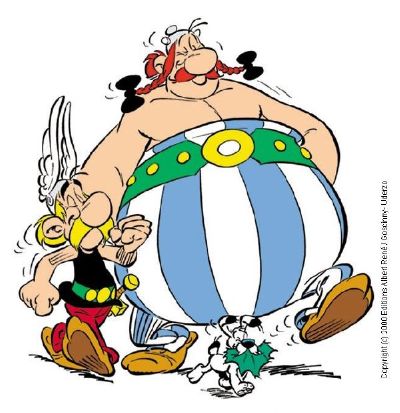
Whenever I need some kind of light reading, which is more often than not, I prefer to read comics. I am a voracious reader of Asterix, Tintin and MAD comics. Even today I raid my wife’s collection of these comics which is almost always up to date. The other day I picked up one from the Asterix series.
I always wonder as to why I am drawn to these comics even though I have read them numerous times?
I am not discovering anything new and the plot follows a predictable sequence of events. In the case of the Asterix series it begins with a crisis in the famous Gaul village, Romans getting bashed up, the pirates having their ship sunk in a skirmish with the heroes and finally not to mention the happy ending with the village feasting on wild boar while Cacofonix is all trussed up. There is a sense of anticipation as I turn the pages every time, anticipation at the inevitable turn of events. I am sure many of you have experienced this.
What is evident from this example is that predictability does not make it any less boring. This holds true for songs, movies, sitcoms anything that has a fan following. All this is a testimony to the fact that there is a sense of joy in the obvious.
This applies to brands too. Why do we tend to use the certain brands over and over again even though there may be better ones?
It could be because we seek comfort in the familiar or there is the inertia to change or whatever. Many a times we hazard a guess for this behaviour that turns out to be way off the mark. Predictability is questioned and made to appear as though it is regressive. Actions are undertaken to overcome this and which very often leads to disaster. A case in point is the Tropicana fiasco.
I think enduring brands are those that have a strong ‘obvious’ gene and know how to play it well. I have never been able to nail the reason beyond this and neither have I come across a convincing answer from the experts. More importantly, do we really need to know the answer and cloud our minds? I think it is best left to behavioural scientists and their rats. Meanwhile it is best to join my favorite comic character, Captain Haddock, in doing what he does best- cursing and drinking.
It has been over 7 months since I left the cozy confines of a high profile agency with nothing but an idea. Along the way I have managed to do very interesting projects for the likes of Wipro Technologies and I am now managing the demands of some very interesting clients.
All this has not prevented me from keeping in touch with my friends in the agency business. The constant refrain I hear from all of them is that they want out. This is across agencies and across cities in India. The only difference being the degree to which the desire has taken root. In fact, a lot of them have made good their word and moved out. Some of them have had their wish of being a client (‘the other side’) fulfilled. However, I am not sure whether they are happy in their new role.
Why am I raising all this here?
I have been blogging for nearly a year now. I have been following blogs a lot longer. A lot is written about new agency models, the role of digital, new age agencies, crowd sourcing, augmented reality and so on. Everyone seems to latch on to a trend and pursue it to death.
I have this to say to my fellow bloggers. Agencies, technologies and management will continue to morph into something new all the time. People are the only constant. It is clichéd but true. However, one will be hard-pressed for ideas in the blogosphere on managing people in a creative environment like an agency. Are people that ‘un-cool’ a topic?
People issue is a serious issue as agencies are struggling to attract and retain talent. Probably it might be an issue only relevant to the Indian market. Indian economy and businesses are booming. They are constantly in search of partners – agency or otherwise – to help them grow even further and faster. However lot of times, agencies fall short of their expectations due to one big reason – lack of talent.
Why are agencies unable to attract and retain talent?
The oft repeated excuse is money. True, but that does not give the full picture. People join an agency with no illusions on the money front (at least in India). What they are hoping for is being part of a thrilling and enjoyable ride called the creative process. The key determinant of any agency to enable this to happen is its culture and leadership. When these two collapse for whatever reason, money definitely begins to matter (as it has reached minimum wage levels in any case). Money then becomes the last straw that broke the camel’s back.
The following stats, based on experience and back of envelope calculations, might give you a sense of what I am talking about.
The average time spent at work is anywhere between 10-15 hours a day, sometimes weekends too. Most of them are youngsters who repose complete faith on their bosses to guide them. Do I need to stress the importance of work culture and leadership?
The average salary of a person with 7-8 years experience (probably a Group Head or Account Director) is roughly 40% less than a person in Marketing with similar experience (or even less)
The average time it takes for a person to understand the client’s business (and needs) is 2-3 months. Match this to the fact that the average life-span of an agency bloke in the business is roughly 15 months (Attrition level is roughly 25%-40%) So a person barely has settled in when he can’t wait to get out
Things are not rosy on the marketing front too. Marketing landscape across categories is changing and becoming increasingly fuzzy. Marketers bank on their agency partners to guide them through the maze. We have a situation where in the client is banking on the agency bloke who in turn is desperately looking to get out. At one level the situation is actually funny and at another it is explosive.
You might wonder whether this is a new phenomenon. No. This has been the norm for a while. The management knows it too. However, in the past replacements and that too good ones were easy to come by. The same cannot be said of today. There are a lot more interesting options for youngsters today.
As with anything related to the agency business, things will begin to move on the people’s front only when the client applies the screws. That day is not far off. It is then that agencies are likely to wake up and probably do something. Why let it reach that stage?
Surely agencies that profess to be in the business of ideas and creative solutions can come up with something interesting to revitalize their own workplace. There are wonderful examples like this one from Pixar for them to get inspiration from.
My friends say that my optimism is misplaced. They seem to have full faith in the indifference of the system to ensure that the status quo is maintained. The operating philosophy seems to be ‘if we can’t manage them, let’s f*ck them’. After all there is a sucker born every second in this blessed country and someone will surely join the system for at least 15 months.
The blogosphere, especially blogs by agency folks, is truly amazing in terms of ideas, analysis and creativity. I only wish a little of it is also channelled into this most important aspect of the agency, the business of people.
This post by Brian Solis has stats to show that social media is dominated by women. I am taking it a step further. I think that social media is a woman and here are seven reasons why I think so.
If you want to make some headway, shut the f*ck up and listen
Remains a conundrum in spite of all the experts and guru’s
Has a long memory and never lets you forget your missteps
Dismissive of fakes and prefers real men
Believes healthy relationships are built when expressing innermost feelings
Everybody knows the impact Twitter had during Iran elections and also during the Mumbai Terror attacks last year. To many the tweets following #Iran elections and #Mumbai represented real news and not just real-time news (I guess, anything is better than the screaming banshees of news channels)
There is also one more use. Sometimes a quick read of tweets pertaining to a ‘hashtag’ can be an indicator of trends or sentiment. Just yesterday my 13-year old niece wanted some help for an essay on wildlife. #wildlife gave me a quick summary on the topic which was not way off the mark. The links provided the support.
Even a mild curiosity is easily addressed by following a ‘hashtag’ tweet-stream, like this one on Gold. A quick run-through of the tweets told me that ‘gold is Gold’ (Couldn’t help the corny comment!)
I do not know whether the sentiment one unearths from ‘hashtags’ are momentary or whether they can stand the scrutiny of experts. However, there is no doubt in my mind that they are a barometer, a quick and useful one at that.