Thursday, April 22, 2010
Calling the bullshit on integrated marketing communication campaigns
(Video courtesy: Ben Kay)
Everyone in the agency business knows that come awards time, agencies will be busy 'creating' integrated campaigns to justify entering the holy grail of all awards - 'The Campaign of the year'. What a bloody waste of time. Instead, agencies are more likely to win an award by doing great work that works. Remember Honda Cog?
This advertiser, Swedish newspaper Dagens Industri, brilliantly spoofs this practice while plugging a case for advertising in their magazine. The video documents how a Japanese car company promoted the launch of a new model … by building an entire zoo.(Source: Adfreak)

Monday, April 12, 2010
Top 10 I wish I had written this (Edition 8)

The posts are not in any order of priority. Hope you like them as much as I did. More importantly, I request you to continue to direct me to more such awesome posts.
What separates good content that is read from good content that is not is your ability to promote it. The author makes a good case for it in the online space. Holds true elsewhere in work too.
A provocative post that caused a raging debate in the blogging and twitter world. It is well thought ends with some useful directions for agencies that I am sure will be ignored!
The author, a musician, says not to make life complicated and to love what we do, and instil it in our actions and our goals. And that is what people actually want to hear from you.
“Try going to work one morning without pants. Then try paying your rent once you’ve been fired. That’s ROI”. Similarly one cannot ignore ROI of Social Media says the author
The author, a copywriter, has written a satirical piece oozing with irony at the state of creative review commenter’s. Made me smile.
Next time someone wants to sell you on a strategy, tell them to show you exactly how they plan to implement it says the author talking about social media. Also true in other aspects of the business.
This is a must-read for anyone from any kind of agency (traditional or digital or whatever) and clients. Inspiring.
This is a simple and practical piece for designers by a designer.
The author, a technologist with deep connection to human behaviour, is pained at the way internet and other gizmos have made us less caring for each other. Extremely insightful.
Today, if an enterprise wants to have access to talent, they have to change. That is because of a whole new generation that the author calls GenerationM (born post 1982) entering it.
(Image courtesy: e_walk)
Monday, April 5, 2010
The Digital Mirage

Digital is a mirage. It will continue to be so for traditional agencies as long as their idea of digital is creating another profit centre and adding few slides at the time of a business pitch. There is need for considerable investment (‘expense’ in traditional agency lingo) For example, hiring people unique to the discipline like interaction designer, creative technologists and many like them costs money. Since this is not so, almost anyone with an email and Facebook account passes of as a digital expert. I won’t be surprised if my college-going-nephew who is into gaming and downloading God-knows-what (bonus marks for porn) is considered a CD material.
Why is this so?
India being a traditional media market, the creative types and agencies do not see any glory beyond the 30 second commercial and print ads. The client too is looking for a solution that is tried and tested. This coupled with lack of understanding of the new media, creates an inertia that is hard to surmount.
More importantly this lack of understanding has resulted in ‘us vs them’ debate between traditional and digital (emerging media). This debate is completely wrong. Digital is not something alien. What is required is to understand how consumers actually interact with media, brands and one another. Thereafter, design a compelling experience (and communication) by extrapolating it to the real world.
The survey mentioned above says it very well.
"Simply doing social and digital, such as creating Facebook accounts and developing banner ads, isn't going to be enough as marketers get hungrier for better direction -- and results -- in the digital/social world. The agency that can help clients understand how to use social/digital and how to integrate these [media] effectively into more traditional initiatives will, in the end, win the day."
Amen.
(Image courtesy:taivasalla)
Monday, March 29, 2010
Are you uncomfortable enough?
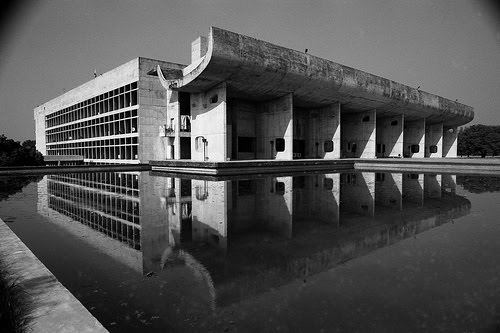
I read this wonderful article yesterday on the idea behind the designs of India’s iconic monuments. The article starts off with Chandigarh, a beautiful city designed by Le Corbusier.
When the city of Chandigarh and its legislative assembly buildings were built, the architecture cast in concrete was very different from the Parliament and other legislative houses built before in India. It looked neither like a palace nor a temple, the two traditional archetypes that served as a model to represent power or ‘culture'. Chandigarh's lexicon of forms was new. Not everyone liked it.
Dismissing the scepticism, Nehru, who ardently supported it, said, “Some like it, and some dislike it… You may squirm at the impact, but it has made you think.”
Nehru, being the Prime Minister, fortunately had the final say and it resulted in one of the finest cities of the world being created. It is another thing that in the ensuing decades we have done our damndest best to reduce it to the chaotic depths of other Indian cities.
More importantly, great ideas will always generate extreme views (and buzz). It will make a lot of people uncomfortable. Therefore, one’s got to be ballsy enough to take a decision in its favor.
(Image courtesy:Ben+_+)
Wednesday, March 17, 2010
Knowing where your client is coming from

Why is marketing increasingly resembling project management? Why are marketers more interested in ticking-off the boxes in their ‘to-do-list’ rather than exploring new ideas?
The above diagram gives the answer to these questions plaguing the minds of many agency folks and surprisingly marketers too. It clearly explains the complexity or challenges facing today’s marketers. Add softer issues like office politics and personal ambition to this and you get one insecure human being.
Not being in a position to handle this ‘kaleidoscope, marketers seek answers from their agencies. Agencies on their part do not want to admit their inability to provide solutions beyond their area of expertise. The outcome is almost always disastrous. This prompts them to lean heavily on consultants and researchers who almost always lead them up the garden path like this case of a great brand like Bud Light.
Alas, there are very few marketers (experts say less than 3%) who are adept at managing this kaleidoscope. The rest, sadly, are glorified project managers busy making life hell for others. Little wonder that the blog ‘Clients from hell’ draws a heavy traffic and a good laugh :-)
(Image courtesy: Bud Caddell)
(Image courtesy: Bud Caddell)
Monday, March 8, 2010
Ad Agencies! Bring back fun, audacity and dreams to the business
Below are two awesome speeches from the Ad Agency Association of America (4A’s) Conference on transforming the ad business. The speeches are raw, short and punchy.
Sean Boyle, Planner JWT NY (Courtesy and via @gapingvoid)
Boy, he does not mince words. More importantly, he not only rants but also gives valuable suggestions. He brutally dismisses all things shallow that is pulling the industry down and wants the fun back in business.
Rishad Tobaccowala (courtesy Tim Malbon)
This is an inspiring speech doing the rounds of blogosphere. Taking a leaf out of Silicon Valley companies, he says that only talent matters and that the ad business needs now is ‘builders’. He signs off beautifully by saying, “You came in with dreams, and now you stand with spreadsheets. Let’s get back to the audacity and the dreams, and the spreadsheets will fill up beautifully.”
Monday, March 1, 2010
Putting your money where your mouth is

“I’m not going to charge you anything now,” she said. “But I want one-tenth of the treasure, if you find it.”
The boy laughed – out of happiness. He was going to be able to save the little money he had because of a dream about hidden treasure!
“Well, interpret the dream,” he said.
“First, swear to me. Swear that you will give me one-tenth of your treasure in exchange for what I am going to tell you.”
The shepherd swore that he would.
“It’s a dream in the language of the world,” she said. “I can interpret it, but the interpretation is very difficult. That’s why I feel that I deserve a part of what you find.”
This is a dialogue from Paulo Coelho’s amazing book ‘The Alchemist’.
The above dialogue can also be allegorical with the shepherd boy representative of a client and the fortune-teller, an agency. Bingo, you get an interesting remuneration model for the agency.
Like the fortune-teller, agencies actions impact the future. These actions are ideas for which agencies expect clients to cough up the dough. And great ideas are not easy to sell. They defy norms and as far as the client is concerned, fraught with uncertainty. Under such circumstances, clients normally tend to play it safe leading to disappointing results and frustration within the agency team.
What if the agency, like the fortune-teller, decides to work for free with a clear understanding that their idea sees the light of day and that they get a share of future profits? This is about putting their money where their mouth is. This display of confidence on the idea can be infectious and hopefully sway the client in favour of the idea.
I am not saying anything new. In an earlier post I had mentioned the famous case of Anomaly and Lauren Luke. In India, my good friend Ramesh has experienced success with a similar approach. It is a workable model for the growing number of independent creative shops across the world. They have nothing to lose and everything to gain - from releasing ‘cutting edge’ work to hopefully making inroads into large agencies businesses.
Large agencies will not be able to do this. They are under the strangle-hold of the bean counters and have a lot to lose. In any case they have already lost something precious .Their guts.
Subscribe to:
Posts (Atom)