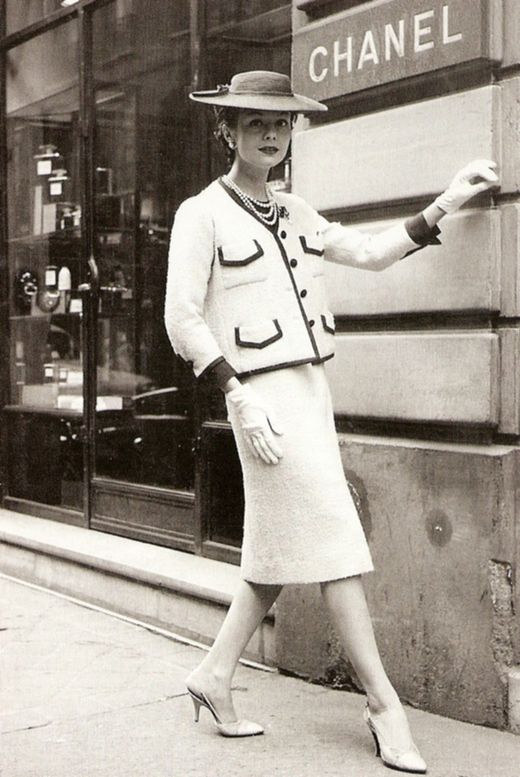
This is my seventh edition and by far the toughest in terms of eliminating some marvellous posts from the list. I chose the most scientific way to prune the list. I tossed a coin (many times over). The posts are not in any order of priority.
‘Be authentic’ in the social space is questioned by the author as he says that this ‘forced authenticity’ is actually making people to be fakes. I concur
Gabrielle Chanel is running a fledgling designer hat business. Depression caused by matters of the heart prompt her to take a break in the sea side resort town of Deauville. There she sees all kinds of people - couples, families, aged, rich, working class – who have converged there to take a break. She sees the men moving about easily and having a whale of time. Women, on the other hand, seem to be constrained by their outfit and having a lot less fun.
She asks, “Why can’t women be as free as men?”
Off go the corsets, long layers of clothing and heavy material like fur. Her mind explodes with ideas. The sketch pad, scissors and the clothiers in Deauville are kept busy. She comes up with a style that shocks the populace at that time. She uses linen, a fabric that is considered inferior. Her style knocks of layers and the hemline shrinks. She also shrinks the cost making her dress extremely affordable. Fashion enters the workplace for the first time. The seeds of Coco Chanel are sown and the rest as they say is history.
Greatness begins with a simple question. The question spells the need clearly. The answer to this question is what results in great brands and great movements. Very often we fail to come up with a simple question and resort to mumbo-jumbo that takes us on a convoluted path down the tubes. You know what I am talking about.
Fortunately for us, the two students below probably asked “How can people find what they are looking for easily on the internet?”
Avinash Kaushik (Analytics Evangelist at Google) in this video (courtesy: Daria) stresses the need for companies to fail faster on the web.According to him, this enables them to rebound faster with a more successful option. And that it could aid even offline activities like TV, Print and so on. I couldn’t agree more.
Offline world is plagued with failures. Experts say that most campaigns, product launches, start-ups and even movies bite the dust in no time. Dismal, isn’t it?
While experts try and find a reason for all this, I decided to wear my philosopher’s hat and invoke Lao Tzu. The result is ‘The Tao of Fail’.
If campaign fails, something is lost. If product fails, something more is lost. If company fails, a lot is lost. If TV Remote fails, everything is lost.
If economy fails and the poor lose their jobs, it is only a correction. If economy fails and investment bankers (and CEO’s) lose their bonuses, it is a catastrophe.
When failing in a job, the wise man quietly adds recommendations to his LinkedIn profile.
Faced with imminent failure, a brave and foolish man merely smiles. Faced with imminent failure, an MBA passes the buck, turns approver and signs a multi-million dollar contract to tell his story.
Night is always followed by day. And...er...by night again.
When all else fails, the wise one with a satisfied burp reaches for some more beer.
Read this interesting article on creativity in the information age. I came to know that the prestigious Sundance Film Festival is creating a new category from 2010, ‘low-or-no budget’ films. I am aware that low-or-no-budget does not necessarily translate to bad quality. However, the director would surely have cut corners more than he or she would have liked. Surprisingly, the directors on their part only seem to be enthusiastic. Michael Mohan, one such director with a film made for less than US$ 50K says, "There's an audience for everything . . . if you say I want to express myself and people will see it, yes, that's what in 2010 you can do."
Why is he so optimistic?
The answer is in the article: ‘Ubiquitous communication and cheap digital technologies are empowering the striving artist who steadily cultivates his or her craft, challenging the cliché of the starving bohemian, or the superstar’.
Let’s shift the scene to 37Signals, a software company I greatly admire. In their famous book, Getting Real, they advise budding start-ups not to seek perfection of their product before launch but to ‘Just wing it’. They should know. That’s just what they do with every new launch of theirs.
Companies like 37Signals are not advocating shoddy or below-par products. On the contrary, their destination is perfection. The digital world is the 'liberal playground' to make this happen,eventually. I am completely fascinated by this and wish it was stressed more often.
Even the critics and cynics of the digital space will agree that they have been able to reach a much wider audience with their criticisms and cynicism of the digital world using the digital world.
Wondered why is the digital world such a liberal world? The following is the best I could come up with as an explanation.
Warts and all are what make us real and human. The digital world gives us the freedom to be ourselves. Our imperfections (as well as perfection) are mirrored in this world creating a kaleidoscope of digital impressions. These impressions are at once organic and open, thereby giving the digital world its liberal side. Am I right?
The auditorium was filling up. The spotlight was on the piano majestically poised on stage. The atmosphere was charged with anticipation. The blokes next to me were discussing the piano on stage, a Yamaha. Their tone was deprecatory. They felt Steinway was superior. I couldn’t help but listen to them as they were clearly audible and oblivious to the fact that people sitting next to them were being disturbed.
Fortunately, the pianist began the recital. The audience were spellbound as the music was simply magical. The pianist ended the recital with a flourish. The audience rose in unison and gave him a standing ovation. The blokes next to me were as enthusiastic as rest of the audience in cheering. I guess, the pianist settled any doubt amongst them conclusively.
It is not about Yamaha or Steinway. It is only music that matters.
People in the business of brands and creative communication (probably in the corporate cesspool too) know that very often the work we do is one big lie. Superficiality rules with the job of ‘sexing up the box’ keeping us busy while being fully aware that the music sucks. When I saw substance being rewarded (for a change) in the form of the audience’s reaction to the piano recital, it made me happy. Nothing beats this experience and therefore I couldn’t help sharing it with you.
The gentleman below, had he been alive, might be in agreement. His MTV Unplugged show was proof of this fact.
I had seen the documentary, courtesy Andy Baio, many months back. I had even tweeted about it. I stumbled upon this again yesterday. It was at once gripping and moving. I thought if something has that effect even after a period of time, it would be worthwhile sharing it.
Mozilla is an inspiring story and proof that a cause that is at once altruistic and game-changing can bring people together against heavy odds. And win. Sit back and enjoy the documentary.
Couple of days back I dropped by a friend’s place. He is a super-geek working for an IT MNC. He was watching India hammer Sri Lanka in the third cricket test match along with his colleagues. This being an unusual event, India hammering Sri Lanka that is, the decibel levels were way above normal. The only time the noise levels dipped a little was during the commercial break. That was when they recharged their batteries with some beer and by letting off steam against any easy target that came their way. The easy target happened to be ads that was aired with annoyingly high frequency on the screen.
My friend, whose sense of humour could be measured in nanobytes, thought he will add to the fun. He mentioned to his inebriated colleagues that until recent past I was an adman and that I was largely responsible for rendering large sections of India catatonic with the ads I had created. It is true, the catatonic part.
These blokes, whose mouths were in a race with their respective bladders for loss of control, decided to play judge and jury by putting me on the dock on behalf of the entire ad industry. They started grilling me about all things advertising. They wanted to know how commercials were made, monies, impact and so on. These were the kind of questions, many of which, even the most knowledgeable ad and marketing bloke would have found daunting. But then they were dealing with me and my bullshit factory with years of practice was on an overdrive. I laid it on thick by describing research, positioning, scripts, storyboard, producers, budgets etc. When I finished my speech, there was the kind of silence wherein you could even hear an ant fart.
Then one of them burped and said with his tongue rolling out-of-control, “whyyy ish everytheeng shame?” (Translation: Why the f*ck does everything look the same?)
It was true. In a short span of time we saw ads for different brands in the same categories all looking the same. The only ad that was interesting and memorable was the Vodafone series. Continuing my role as a defendant, I gave them a corny answer for this obvious lack of differentiation amongst ads. I said something to the effect that “different people can have the same creative idea”. It was very evident that I was desperately scrapping the bottom of my bullshit barrel and that it was time to make a quiet exit.
Fortunately, the discussion took an interesting turn. They turned their attention to the tech industry and started debating as to how software and other tech stuff did not differ from one company to another. Interestingly, the word they used was ‘mimic’. Then the discussion moved to cars. One bloke said that he had recently purchased a Honda City and that he found very little difference between various car models when he did the homework for buying a car. In fact, the debate only brought to light the fact there were little difference between various products and brands.
Therefore the question, “If everything is the same, where on earth is creativity?”
“Their key insight is that creative ideas can only spread if they're actually adopted by others. Too much creativity, and there's not enough imitation--ideas die on the vine, because there are so many of them and few ever catch fire. For good ideas to spread, there's an optimal balance to be reached between creating and imitating.”
The figure by some gobbledygook magic is that only 30% create and the rest imitate. In my opinion that is a very optimistic figure. In the case of ad industry it is likely to be much lower. Even the scam ads seem to ‘mimic’ one another.
In a different and lighter vein, John Dodds says in a post on big ideas that “probably only fire and alcohol could be classified as a big idea and the rest debatable”. I concur. I might have included the wheel to the list. I am not fussy, though.
So folks, if you copy you are in good (and large) company. So set forth and copy. If you do copy, be smart enough not to get caught. And if you do get caught, be smart enough not to get caught with a bunch of drunks. If you copy, get caught and find yourself in the company of drunks, be kind enough to buy them a round of drinks. Cheers!